
01
A lintel, not a freestanding stela
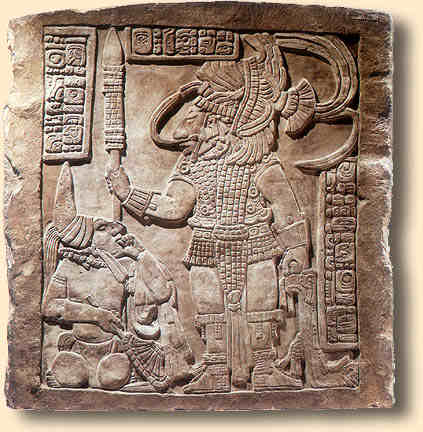
This monument from Yaxchilan has sometimes been described as “Stela 16,” but it is more accurately known as Lintel 16. A lintel is a stone beam placed across the top of a doorway. Its carved underside would have been seen by someone passing beneath it, so the original viewing angle was very different from that of an upright museum display.
Yaxchilan stands beside the Usumacinta River in present-day Chiapas, Mexico. During the Classic period its rulers commissioned an exceptional series of carved lintels. Their images and inscriptions connect royal ceremonies, warfare, ancestry, and calendrical statements.
02
Image and event
The carving presents a dramatic unequal encounter. A richly dressed ruler stands at the right, holding a long spear. A smaller captive kneels at the left with bound arms. Costume, scale, gesture, and position identify the victor and the defeated figure before the inscription is read.
The standing ruler is identified as Yaxun Balam IV, also widely called Bird Jaguar IV in older literature. He was one of Yaxchilan’s most prolific royal patrons. The kneeling figure is a captured lord whose name and titles are given in the text.
The image does not merely illustrate a battle. It stages the political result: the ruler’s power is made visible through the captive, and the text turns that display into a dated historical claim.
03
Where the reading begins
Maya inscriptions are arranged in glyph blocks. Readers normally follow paired columns from left to right and top to bottom, although the composition of a monument can modify that pattern. On Lintel 16 the carved texts occupy distinct panels around the figures. Each panel contributes names, titles, actions, or dates.
The calendrical passage records the Calendar Round as 6 Kaban 5 Pop, accompanied by the Long Count 9.16.0.13.17. Using the correlation adopted by this site, it places the event on 6 February 752 in the Julian calendar.
A Calendar Round date alone would recur after 18,980 days. The Long Count removes that ambiguity by locating the event within a much larger elapsed-day sequence. This is exactly why the systems appear together on historical monuments.
04
The Long Count on the monument
The five principal Long Count positions name bak’tun, k’atun, tun, winal, and k’in. Their coefficients are 9, 16, 0, 13, and 17. Read as place values, the sequence counts nine periods of 144,000 days, sixteen periods of 7,200 days, no complete 360-day tuns, thirteen periods of 20 days, and seventeen individual days.
The coefficient zero is an essential part of the written date. It holds the tun position between k’atun and winal. Without it, the following values would shift and produce a different elapsed-day total. This is positional notation in practice.
The Tzolk’in and Haab signs then name the same day within their repeating cycles. The agreement among these components allows epigraphers to check the reading: the Long Count must calculate to the Calendar Round combination written beside it.
05
Names, titles, and verbs
After the date, the inscription identifies what happened and who took part. It contains a capture verb often transliterated as chukaj—“was captured”—followed by the name of the kneeling prisoner. The victor’s name and titles occupy another portion of the monument.
Royal names are not simple labels. A ruler can be identified through a personal name, emblem glyph, dynasty or place affiliation, accession statement, and age title. The title “three-k’atun lord” indicates a ruler who had lived through three completed k’atun periods. Such titles placed an individual life within the same calendrical framework used for public history.
Some glyphs also point to supernatural or ritual roles. The older essay connects parts of the ruler’s titulary with rainmaking and shamanic authority. Those interpretations reflect the state of epigraphic study when the article was written and should be read as part of that history of scholarship.
06
Why the date matters
The precision of the date makes the carving historical evidence. It relates the capture to other inscriptions at Yaxchilan and neighboring cities, allowing researchers to reconstruct sequences of conflict, alliance, succession, and monument dedication.
Yaxun Balam IV’s reign followed a difficult interval in Yaxchilan’s dynastic record. His monuments repeatedly emphasize legitimate ancestry, powerful allies, captives, and ceremonial action. Lintel 16 participates in that program: the ruler’s authority is asserted through both the image of victory and the exact placement of the event in time.
This is the larger lesson of reading a Maya date. The numbers are the beginning, not the end. Once a day is located, it opens onto people, verbs, places, political aims, and the physical setting of the monument itself.
07
From diagram to monument
The interactive vertical stela on this website teaches the principal date components in a regular column. A real inscription is more complex. Coefficients may use head variants, period signs can be compressed, and the reading order responds to the carved composition.
The simplified tool is therefore best used as a key. It helps visitors recognize the Long Count, Tzolk’in, and Haab before returning to an object such as Lintel 16, where those systems become part of a historical statement made in stone.