
01
A living culture and a long history
The people known collectively as the Maya developed one of the great civilizations of the ancient Americas. Their cultural region extended across the Yucatán Peninsula, Guatemala, Belize, and parts of Honduras and El Salvador. Millions of Maya people live in this region today, and many continue to speak languages belonging to the Mayan language family.
That continuity matters because the Maya are not only an archaeological subject. Ancient cities, inscriptions, and painted books belong to a history that is also carried by living communities. The calendar systems described here grew within that history and cannot be separated from it.
Archaeologists divide the ancient history of the region into broad periods. During the Preclassic, communities expanded, agriculture intensified, and ceremonial centers developed. The Classic period, conventionally dated from about AD 250 to 900, saw the flourishing of many cities, royal dynasties, monumental art, and long hieroglyphic texts. In the Postclassic, political centers shifted and new regional powers emerged before and during the Spanish invasion of the sixteenth century.
02
Writing history in stone and in books
Maya writing combined signs representing words with signs representing syllables. Scribes used this flexible system to record names, titles, births, accessions, rituals, conflicts, alliances, and deaths. On stone monuments, dates often organize the text: they locate an event in time and connect it to dynastic history, ritual cycles, and the actions of rulers.
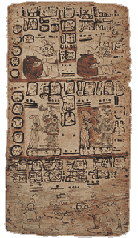
Stelae, lintels, altars, stairways, painted vessels, and architectural panels preserve thousands of inscriptions. The Maya also painted folding books on prepared bark paper. Only four codices are generally recognized today—the Dresden, Madrid, Paris, and Maya Codex of Mexico—but their pages preserve dense tables of calendrical, astronomical, and ritual information.
This record-keeping tradition is why the calendar is so visible in Maya studies. Dates are not isolated mathematical exercises. They are part of sentences, images, ceremonies, and political arguments made by historical people.
03
Mathematics, astronomy, and the calendar
Maya mathematicians independently developed a positional number system based principally on groups of twenty, written with dots, bars, and a sign for zero. This use of zero was established in Maya notation centuries before zero became common in European arithmetic. By preserving an empty place, zero made large values unambiguous and gave scribes an essential tool for recording long spans of time.
Mathematics worked together with careful observation of the sky. Maya specialists tracked repeating movements and organized time through several interlocking systems. The 260-day Tzolk’in named days by combining a cycle of thirteen numbers with twenty day names. The 365-day Haab organized a solar year into eighteen periods of twenty days followed by five additional days. Together, the two counts produced a larger cycle now called the Calendar Round.
For dates that had to be placed across much longer spans, scribes used the Long Count. It expressed the number of days elapsed from a conventional starting point through a sequence of place values. Positional notation and zero enabled specialists to calculate across centuries and construct calendrical and astronomical tables that tracked recurring phenomena.
These systems were complementary. A monumental date could name the day in the Tzolk’in and Haab while also fixing it within the Long Count. Other cycles could be added when they mattered to the event or the text.
04
Change, survival, and rediscovery
The political transformation often called the “Classic Maya collapse” was not the disappearance of the Maya. During the eighth and ninth centuries, many southern lowland courts stopped erecting dated monuments and several large cities lost population. Other communities continued, reorganized, or grew elsewhere. Postclassic centers in northern Yucatán and the highlands remained active for centuries.
Colonial violence destroyed lives, institutions, and manuscripts, but Maya knowledge did not simply vanish. Alphabetic books such as the Books of Chilam Balam preserved histories, calendrical knowledge, and community traditions in Maya languages written with Latin letters. Contemporary ritual specialists and communities also maintain calendrical practices in parts of the Maya world.
Modern decipherment has changed how ancient inscriptions are understood. What once appeared to be a silent system of priestly numbers is now read as a historical script with named people, places, and events. The calendar remains the entry point: it provides the framework through which those histories can be placed in time.