
01
A positional system with zero
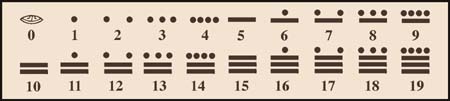
Maya mathematicians independently developed a vigesimal positional number system: its place values are based principally on groups of twenty. A dot represents one, a bar represents five, and a shell-shaped sign represents zero. This use of zero was established in Maya notation centuries before zero became common in European arithmetic.
By combining dots and bars, a scribe could write every digit from 1 through 19, while the zero sign held an empty position. The signs are simple, but place value allows them to express very large numbers clearly. Just as the Arabic numeral 31 means three tens plus one, a Maya positional number gains value from the level in which each digit appears.
02
Position gives value
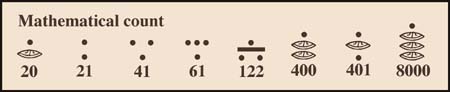
In ordinary vigesimal notation, the lowest position contains units. The next position counts twenties, the next four hundreds, then eight thousands, and so on. If the notation is vertical, the lowest-value position is normally at the bottom and higher values rise above it. Horizontal arrangements are also known, with values ordered across the line.
A zero is essential when a position has no units but a higher position is occupied. It preserves the place in the same way that the zero in 101 distinguishes one hundred and one from eleven.
03
The calendrical adjustment
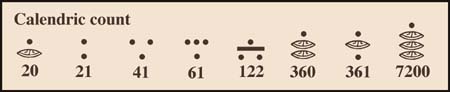
Long Count notation modifies the third place. Instead of 20 × 20 = 400 days, eighteen winals make one tun of 360 days. The sequence used for the familiar five-part date is therefore 1, 20, 360, 7,200, and 144,000 days.
This adjustment keeps the tun close to the length of a solar year while retaining the convenience of multiplication by twenty for the higher positions. It also explains why a Long Count cannot be converted correctly by treating every place as an ordinary base-twenty digit.
- Ordinary vigesimal values: 1, 20, 400, 8,000…
- Long Count values: 1, 20, 360, 7,200, 144,000…
04
Reading an example
Take the Long Count 9.16.0.13.17. Read from left to right, it contains 9 bak’tuns, 16 k’atuns, 0 tuns, 13 winals, and 17 k’ins. Multiplying each coefficient by its period value and adding the results gives the total elapsed days from the count’s conventional starting point.
The zero in the tun position is not optional: it shows that no full tuns are added between the sixteen k’atuns and the thirteen winals. On a monument, each coefficient is paired with its period sign, making the place value visible through both position and glyph.
05
Mathematics in context
Maya mathematics was foundational to sophisticated calendrical and astronomical work. Positional notation and zero made it possible to record long spans unambiguously, coordinate cycles of different lengths, and construct tables that tracked recurring solar, lunar, and planetary phenomena.
Mathematics also supported architecture, tribute, exchange, and administration. Surviving codices show calculation, observation, and ritual interpretation operating together rather than as separate subjects.
The teaching diagrams on this site isolate the numerals so that their logic is easy to see. Ancient inscriptions are more varied and calligraphic, but the underlying principles—coefficient, place, and zero—remain recognizable.