01
More than one way to locate a day
There is no single Maya calendar. Ancient inscriptions and codices use several counts, each answering a different question. One identifies a day within a 260-day ritual cycle. Another locates it within a 365-day year. A third combination distinguishes dates across a cycle of roughly fifty-two years, while the Long Count places events across far longer spans.
The systems appear together because each contributes different information. A complete monumental date may resemble a set of coordinates: several expressions converge on the same day.
02
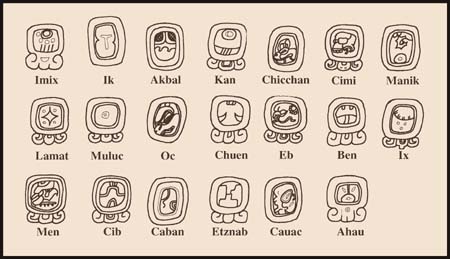
The Tzolk’in: 260 named days
The Tzolk’in combines thirteen numbers with a fixed sequence of twenty day names. Both advance by one each day. After 13 the number returns to 1, while the day-name cycle continues until its twentieth sign and then begins again. A combination such as 4 Ajaw will recur after 260 days, the first point at which both cycles return to their starting relationship.
The 260-day count has ritual and divinatory importance and remains in use in some Maya communities. In older English-language writing it is often called the Sacred Round or Sacred Almanac. The word Tzolk’in itself became common in modern Yucatec Maya and scholarly usage.
03
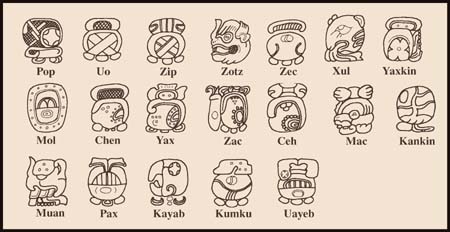
The Haab: a 365-day year
The Haab consists of eighteen named months of twenty days, followed by a short five-day period called Wayeb. Its total is 365 days. In a Haab date, a coefficient accompanies the month name. Older conventions often number the ordinary month days from 0 to 19; the five Wayeb days are likewise counted within their shorter period.
The related tun is a period of 360 days used in Long Count reckoning. It is not simply another name for the Haab. The difference matters: the Haab follows a 365-day cycle, while the tun provides the regular 18 × 20 unit used to build larger Long Count periods.
04
The Calendar Round
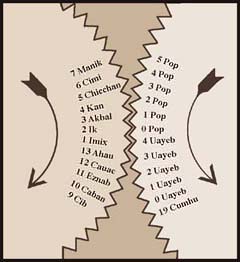
A Tzolk’in designation and a Haab designation can be stated together—for example, 4 Ajaw 8 Kumk’u. The same pair does not recur every 260 or 365 days. It returns after 18,980 days: fifty-two Haab years or seventy-three Tzolk’in cycles. Scholars call this larger repeating interval the Calendar Round.
Imagine two interlocking wheels, one carrying the 260-day sequence and the other the 365-day sequence. Each daily step changes both readings. Only after all 18,980 combinations have passed do the same positions meet again.
05
The Long Count
The Calendar Round is excellent for naming days within a human lifetime, but the same combination returns after about fifty-two years. When a text needs an unambiguous position across centuries, the Long Count supplies it. Its place values count elapsed days from a mythic starting point.
On this site a result such as 13.0.13.13.9 is read from the largest period to the smallest: bak’tun, k’atun, tun, winal, and k’in. A zero coefficient is not a blank: it holds a period’s position so the values on either side retain their meaning. This positional precision allows the Long Count to distinguish dates across centuries.
The accompanying Tzolk’in and Haab designations describe the same day through their repeating cycles. Correlation constants are scholarly conventions used to align this count with European calendars; the converter states which one it uses.