
01
K’in: the day
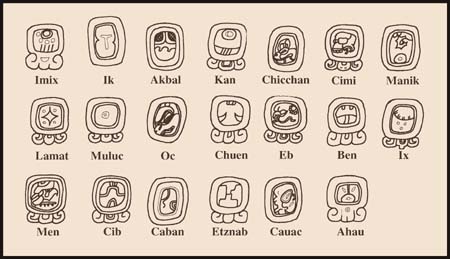
The smallest whole unit in the calendrical count is the k’in, or day. A Tzolk’in date combines a coefficient from 1 to 13 with one of twenty day names. In inscriptions, the day name is represented by a glyph whose appearance may change with artistic style and context.
The glyphs shown here are teaching forms, not a complete catalogue. Ancient scribes could use several graphic variants for the same word, and signs were often combined, abbreviated, or shaped to fit a particular block.
02
Winal and Wayeb
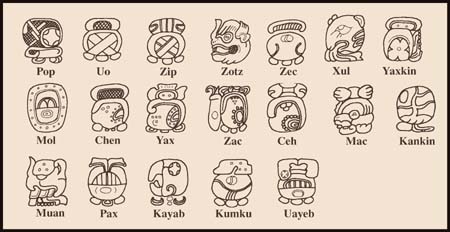
The Haab is divided into eighteen periods of twenty days. These twenty-day periods are commonly called winals, using a modern normalized spelling of the word that older sources often wrote as uinal. The year ends with Wayeb, a period of five additional days.
A Haab date joins a day coefficient to a month sign. Together with the Tzolk’in date, it forms a Calendar Round designation. Because that pairing repeats only after 18,980 days, it identifies a day within a span of approximately fifty-two Haab years.
03
Numerical coefficients
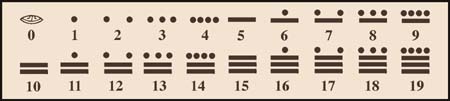
Maya numbers can be written with three basic forms: a dot for one, a bar for five, and a shell-like sign for zero. Combinations of dots and bars express the values from 1 to 19. The coefficient belongs with the glyph beside it, so spacing and order matter when a date is read.
The zero sign does more than represent an absence. In a positional date it holds an unoccupied period so the values above and below it cannot shift. A zero coefficient is therefore essential to an accurate Long Count reading.
On a vertical monument, signs are generally followed through the designed sequence of glyph blocks. The interactive stela on this site simplifies that arrangement into a single vertical reading: the coefficient appears beside the period or day sign it modifies.
04
Long Count place values
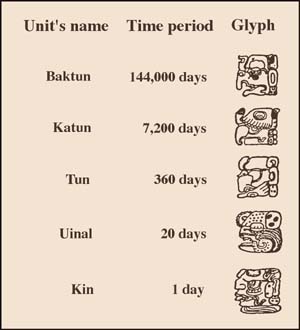
The five positions most often shown in an introductory Long Count date are bak’tun, k’atun, tun, winal, and k’in. A k’in is one day; a winal is 20 days; a tun is 18 winals or 360 days; a k’atun is 20 tuns or 7,200 days; and a bak’tun is 20 k’atuns or 144,000 days.
The 360-day tun is the important calendrical exception to a pure base-twenty sequence. After the winal position, eighteen rather than twenty winals make one tun. The higher periods then resume multiplication by twenty.
- 1 k’in = 1 day
- 1 winal = 20 k’in = 20 days
- 1 tun = 18 winals = 360 days
- 1 k’atun = 20 tuns = 7,200 days
- 1 bak’tun = 20 k’atuns = 144,000 days
05
A date as a coordinated statement
When these elements appear together, they do more than display a number. The Long Count gives an elapsed-day position, the Tzolk’in names the ritual day, and the Haab locates it within the 365-day cycle. Supplementary signs can add lunar information, patron deities, or other cycles.
The result is a layered statement about time. Learning to read it begins by separating the components and then recognizing how they converge on one day.